pro-Caspase 3 Recombinant Rabbit Monoclonal Antibody (SZ02-08), Invitrogen™
Manufacturer: Thermo Scientific
Select a Size
| Pack Size | SKU | Availability | Price |
|---|---|---|---|
| Each of 1 | PIMA532027-Each-of-1 | In Stock | ₹ 46,413.50 |
PIMA532027 - Each of 1
In Stock
Quantity
1
Base Price: ₹ 46,413.50
GST (18%): ₹ 8,354.43
Total Price: ₹ 54,767.93
Antigen
pro-Caspase 3
Classification
Monoclonal
Concentration
1 mg/mL
Formulation
TBS with 0.05% BSA, 40% Glycerol and 0.05% sodium azide, pH 7.4
Gene Accession No.
P42574, P70677
Gene Symbols
CASP3
Immunogen
Synthetic peptide within Human pro Caspase-3 aa 18-67
Quantity
100 μL
Primary or Secondary
Primary
Target Species
Human, Mouse
Product Type
Antibody
Isotype
IgG
Applications
Flow Cytometry, Immunocytochemistry, Immunohistochemistry, Western Blot, Western Blot
Clone
SZ02-08
Conjugate
Unconjugated
Gene
CASP3
Gene Alias
A830040C14Rik, AC-3, Apopain, Casp3, CASP-3, caspase 3, caspase 3, apoptosis related cysteine protease, caspase 3, apoptosis-related cysteine peptidase, caspase 3, apoptosis-related cysteine protease, caspase-3, Caspase-3 subunit p12, Caspase-3 subunit p17, CC3, Cpp32, CPP-32, CPP32B, cysteine protease CPP32, LICE, mLdy, PARP cleavage protease, procaspase3, protein Yama, SCA-1, SREBP cleavage activity 1, Yama
Host Species
Rabbit
Purification Method
Protein A
Regulatory Status
RUO
Gene ID (Entrez)
12367, 836
Content And Storage
Store at 4°C short term. For long term storage, store at -20°C, avoiding freeze/thaw cycles.
Form
Liquid
Related Products

Description
- Recombinant rabbit monoclonal antibodies are produced using in vitro expression systems
- The expression systems are developed by cloning in the specific antibody DNA sequences from immunoreactive rabbits
- Then, individual clones are screened to select the best candidates for production
- The advantages of using recombinant rabbit monoclonal antibodies include: better specificity and sensitivity, lot-to-lot consistency, animal origin-free formulations, and broader immunoreactivity to diverse targets due to larger rabbit immune repertoire
- Caspases are a family of cysteine proteases that are key mediators of programmed cell death or apoptosis
- The precursor form of all caspases is composed of a prodomain, and large and small catalytic subunits
- The active forms of caspases are generated by several stimuli including ligand-receptor interactions, growth factor deprivation and inhibitors of cellular functions
- All known caspases require cleavage adjacent to aspartates to liberate one large and one small subunit, which associate into a2b2 tetramer to form the active enzyme
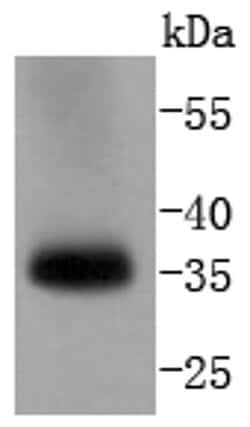
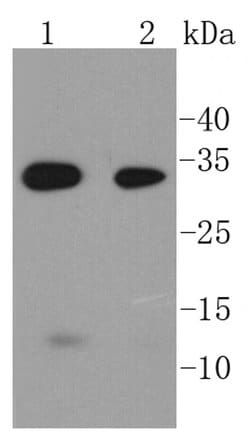
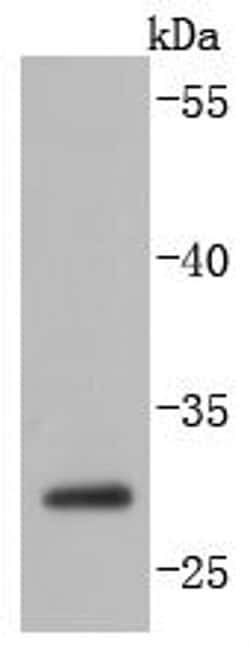
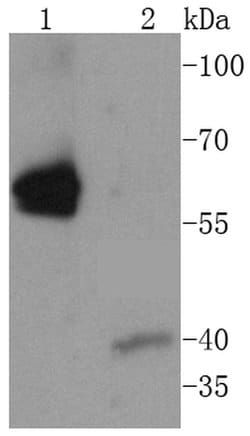
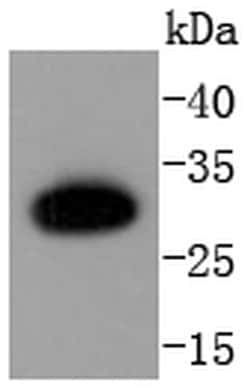
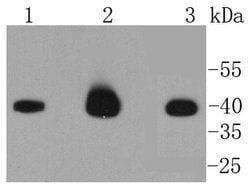
- Gene for Caspase-3 also known as Yama, CPP32, and apopain codes for a 32-kDa protein
- Caspase-3 cleaves the death substrate poly(ADP-ribose) polymerase (PARP) to a specific 85 kDa form observed during apoptosis and is inhibitable by the CrmA protein
- Other Caspase-3 substrates include DNA-PK, actin, GAS2, and procaspase-6, etc
- Caspase-3 is activated by cleavage events at Asp-28/Ser-29 (between N-terminal pro-domain) and Asp-175/Ser-176 (between large and small subunits) to generate a large subunit of 17-kDa and a small subunit of 12-kDa.