Caspase 9 Recombinant Rabbit Monoclonal Antibody (SC65-05), Invitrogen™
Manufacturer: Thermo Scientific
Select a Size
| Pack Size | SKU | Availability | Price |
|---|---|---|---|
| Each of 1 | PIMA532257-Each-of-1 | In Stock | ₹ 47,481.50 |
PIMA532257 - Each of 1
In Stock
Quantity
1
Base Price: ₹ 47,481.50
GST (18%): ₹ 8,546.67
Total Price: ₹ 56,028.17
Antigen
Caspase 9
Classification
Monoclonal
Concentration
1 mg/mL
Formulation
TBS with 0.05% BSA, 40% Glycerol and 0.05% sodium azide, pH 7.4
Gene Accession No.
P55211, Q8C3Q9
Gene Symbols
CASP9
Immunogen
Recombinant protein within Human Caspase-9 aa 95-335
Quantity
100 μL
Primary or Secondary
Primary
Target Species
Human, Mouse
Product Type
Antibody
Isotype
IgG
Applications
Western Blot
Clone
SC65-05
Conjugate
Unconjugated
Gene
CASP9
Gene Alias
25 kDa caspase-9 dominant negative protein, AI115399, APAF3, APAF-3, apoptotic protease activating factor 3, apoptotic protease MCH-6, Apoptotic protease-activating factor 3, AW493809, cas9, CASP 9, CASP9, CASP-9, Casp9_v1, Casp-9-CTD, caspase 9, caspase 9, apoptosis-related cysteine peptidase, caspase 9, apoptosis-related cysteine protease, Caspase9, caspase-9, caspase-9 dominant negative form, Caspase-9 precursor, Caspase-9 subunit p10, Caspase-9 subunit p35, CASPASE-9c, caspase-9-carboxyl-terminal divergent, CTD, Ice-Lap6, ICE-like apoptotic protease 6, Mch6, OTTHUMP00000002324, PPP1R56, protein phosphatase 1, regulatory subunit 56, RNCASP9, RP11-265F14.3
Host Species
Rabbit
Purification Method
Protein A
Regulatory Status
RUO
Gene ID (Entrez)
12371, 842
Content And Storage
Store at 4°C short term. For long term storage, store at -20°C, avoiding freeze/thaw cycles.
Form
Liquid
Related Products
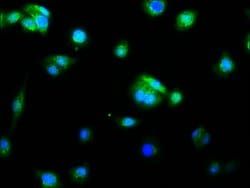
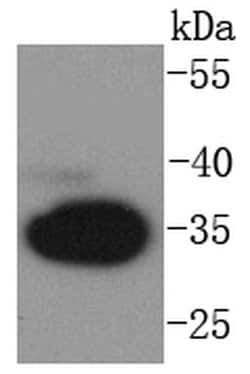

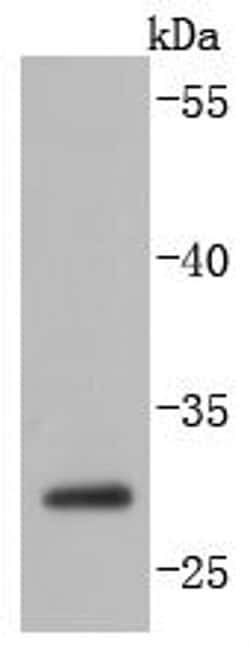
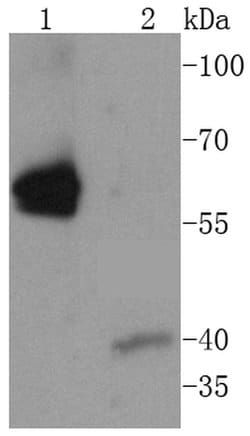
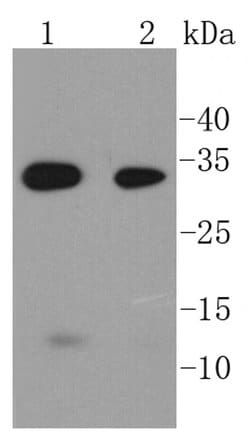
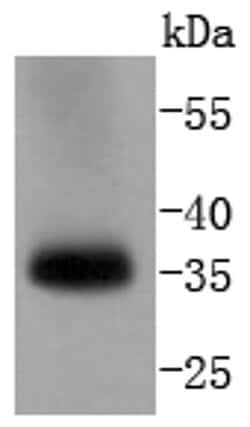
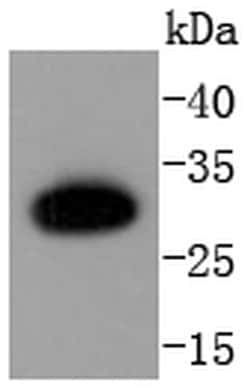
Description
- Recombinant rabbit monoclonal antibodies are produced using in vitro expression systems
- The expression systems are developed by cloning in the specific antibody DNA sequences from immunoreactive rabbits
- Then, individual clones are screened to select the best candidates for production
- The advantages of using recombinant rabbit monoclonal antibodies include: better specificity and sensitivity, lot-to-lot consistency, animal origin-free formulations, and broader immunoreactivity to diverse targets due to larger rabbit immune repertoire
- Caspase 9 (ICE-like apoptotic protease 6, ICE LAP6, apoptotic protease Mch6, apoptotic protease activating factor 3, Apaf3) is a member of the peptidase family C14 that contains a CARD domain
- Caspases are cysteine proteases, expressed as inactive precursors, that mediate apoptosis by proteolysis of specific substrates
- Caspase 9 is active as a heterotetramer, is present in the cytosol and, upon activation, translocates to the mitochondria
- Caspase 9 is involved in the caspase activation cascade responsible for apoptosis execution and cleaves/activates Caspase 3 and Caspase 6
- Further, Caspase 9 is involved in the activation cascade of caspases responsible for apoptosis execution
- Binding of caspase-9 to Apaf- 1 leads to activation of the protease which then cleaves and activates caspase-3
- Caspase 9 promotes DNA damage-induced apoptosis in a ABL1/c-Abl-dependent manner, and proteolytically cleaves poly(ADP- ribose) polymerase (PARP)
- Caspase 9 is expressed in variety of human tissues
- An isoform of rat Caspase-9 has been identified in which the C terminus of full-length Caspase-9 is replaced with an alternative peptide sequence
- Mutations in Caspase 9 affect brain development
- In mice, insufficient Caspase 9 have resulted in abnormal cerebrum development and neuron development
- In humans, dysfunctional Caspase 9 expression vary from tissue to tissue
- Low levels of Caspase 9 may play a role in cancer development and neurodegenerative diseases such as Alzheimer’s Disease (AD).